
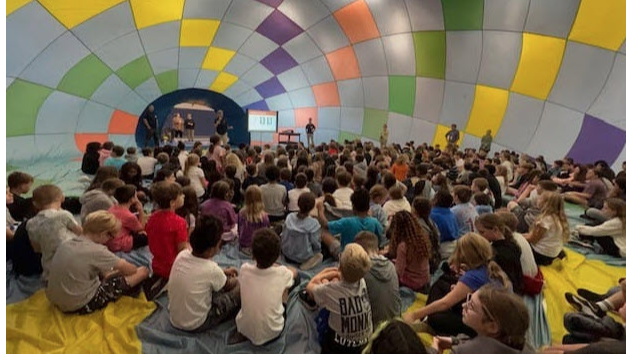
Assemblies are a familiar part of the school year, yet parents and educators alike often wonder whether a single program can change how children feel about a subject. Science is a useful test case because student interest in it has dropped in recent years. According to Academic Entertainment, an assembly’s effectiveness depends on factors such as timing, topic choice, feedback, and how well the program reaches different kinds of learners. That view offers a practical way to judge the value of any science program.
What National Data Reveals About Science Interest
The 2024 National Assessment of Educational Progress shows the scale of the challenge. According to the National Assessment Governing Board, the share of eighth graders who reported often or always taking part in inquiry-related activities in class fell from 17% in 2019 to 14% in 2024. The data also showed that students who participated in scientific inquiry were more likely to score higher on the NAEP science assessment. These findings suggest that engagement and hands-on experience are closely linked, and that link is where a well-designed assembly can contribute.
Participation Separates Effective Programs from Passive Ones
A science assembly where children only sit and watch works much like a lecture. Programs that bring volunteers on stage, invite predictions from the audience, and let students see outcomes they helped create tend to hold attention longer. Participation turns abstract ideas like air pressure or chemical reactions into something children experience firsthand, not just facts they were told. Presenters who respond in real time to audience reactions also keep younger students focused. A useful measure of any program is how many children take an active role and whether the audience stays involved throughout or only at the end.
Timing and Curriculum Fit Shape Results
Scheduling has a direct effect on how much students retain. A program held during a testing week competes with stress and fatigue, while one tied to a current science unit or science fair builds on material students are already studying. Some schools schedule a program at the start of a unit to spark questions, while others use it at the end as a review. When demonstrations connect to classroom content and science standards, teachers can refer back to the assembly in later lessons, which turns a one-day event into part of a longer learning sequence.
Matching Content to Age and Learning Style
A kindergartner and an eighth grader respond to very different pacing, vocabulary, and humor. Many schools split audiences into younger and older sessions so content can be adjusted for each group. Effective programs also reach several learning styles at once. Visual learners follow the demonstrations, auditory learners follow the explanations, and hands-on learners benefit from participating directly. Programs that accommodate children with a range of needs, including those in special education settings, extend the benefit to every student in the audience.
Extending the Impact at School and at Home
Much of an assembly’s value depends on what happens afterward. Teachers can revisit a demonstration in class or ask students to explain what they observed. Parents play an equally important role. Asking a child to describe the most surprising experiment, or recreating a simple version with items from the kitchen, reinforces the concepts and signals that science matters outside the classroom. Feedback from students, staff, and families also helps schools judge whether a program met its goals.
Setting Realistic Expectations for a Single Program
No single assembly can reverse a national trend, and families and schools should not expect it to. A science program works best as a spark within a broader pattern of hands-on learning, both in the classroom and at home. Against that goal, a participatory and well-timed assembly can renew curiosity and give students, teachers, and parents a shared reference point for the weeks ahead.
Academic Entertainment
Info@AcademicEntertainment.com
+1 800 883 9883
1495 Lost Trail Drive
Pullman
Washington
99163
United States


