SHENZHEN, GUANGDONG, CHINA, October 16, 2026 /EINPresswire.com/ — Balancing Longevity and Precision in Publishing
A single Bible can contain over 1,200 pages compressed into a volume barely two inches thick, yet it must survive decades of daily handling without pages loosening or ink bleeding through. This physical paradox defines one of the most demanding challenges in modern publishing. Addressing it requires more than standard bookbinding capabilities. Publishers increasingly rely on a specialized China Professional Bible Printing Manufacturer to balance spiritual solemnity with industrial durability. CAIMEI (Shenzhen Cai Mei Plus Printing Co., Ltd.,) has established itself within this niche, converting complex theological layout requirements into physical books that meet international standards.
For over two decades, the manufacturing landscape for religious literature has shifted toward structured, comprehensive production ecosystems. Global demand for religious texts remains steady, but international publishers now expect greater technical precision. Modern religious publishing demands exceptional material longevity, exact textual alignment, and cost-effective production scaling. CAIMEI meets these demands by combining precise machinery with traditional craftsmanship. Operating from large-scale facilities in China, the company runs ten advanced printing machines alongside hundreds of specialized binding systems to serve international markets, balancing volume efficiency with meticulous detail.
Adapting Global Texts for Regional Readers
The production of religious literature requires a high degree of textual adaptability. Theological publications circulate in thousands of languages and diverse translations, such as the King James Version (KJV) and the New International Version (NIV). Each version introduces unique typographical characteristics, text lengths, and paragraph structures. Shenzhen Cai Mei Plus Printing Co., Ltd. manages these variations through structured prepress workflows that preserve textual integrity across different scripts and layouts.
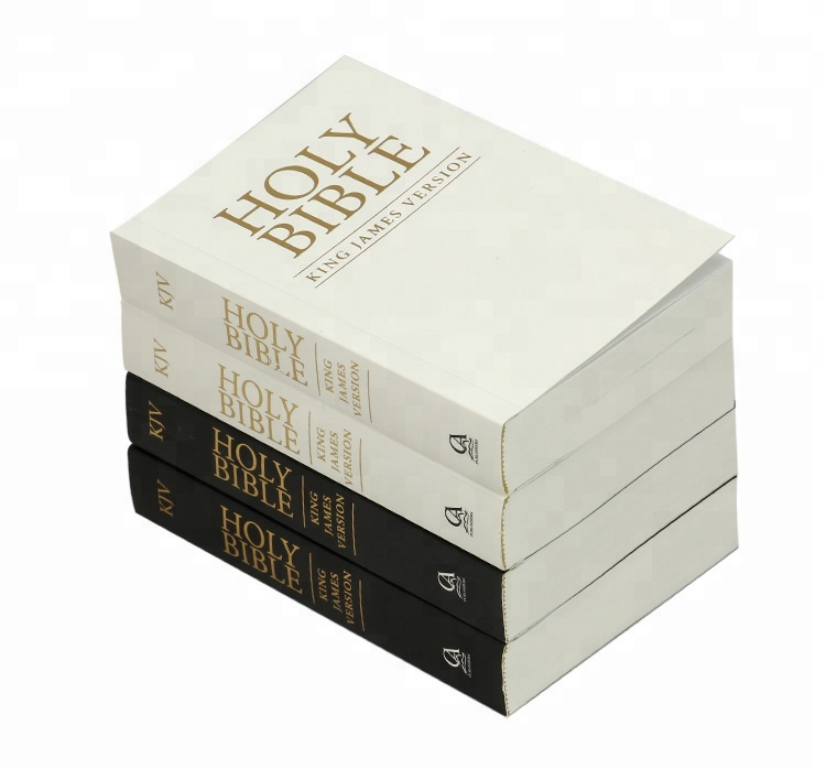
Practical experience reinforces this capability. CAIMEI has produced compact KJV pocket editions for a North American Christian distributor, delivering leather-look softcover Bibles on 30gsm paper with gilded edges and dual ribbon markers. For a European ministry publisher, the factory handled a large-print NIV study edition featuring double-column text, center-column references, and extensive footnotes across more than 1,500 pages. Multilingual projects have included Spanish and Portuguese Scripture editions for Latin American markets, each requiring careful text reflow to match regional reading habits.
Beyond linguistic diversity, publishers must cater to distinct usage environments. A heavy leather-bound volume used on a church altar serves a different purpose than a compact, flexible edition carried by a traveler. To meet these varied needs, CAIMEI provides versatile manufacturing paths, including rigid hardcover casings, flexible softcover bindings, and premium imitation leather covers. This flexibility keeps the final product aligned with the practical demands of its intended environment, whether that involves formal liturgical settings or daily personal study.
Material Integrity and Technical Execution in Bible Printing
The physical construction of a religious text presents unique engineering challenges, particularly regarding paper selection and ink application. Printing a 1,200-page Bible on 28gsm paper requires high-tack ink formulations to prevent “ghosting” or ink strike-through on ultra-thin substrates. This technical challenge is unique to religious and reference text publishing, where thickness must stay minimal to keep the volume portable. Most traditional scripts require thin, lightweight paper—often ranging from 28gsm to 40gsm—to keep a multi-thousand-page volume compact and manageable. As a specialized China professional Bible printing manufacturer, CAIMEI operates the machinery needed to handle lightweight “onion skin” papers without tearing or wrinkling. This technical synchronization keeps dense, double-column layouts legible and preserves a clean reading canvas for the user.
Durability depends heavily on the chosen binding methodology. The binding of a Bible is equally critical. These books often serve a lifetime of daily use, so CAIMEI applies Smyth sewing with reinforced nylon thread. This method delivers the durability needed to withstand thousands of “open and close” cycles. Smyth sewn binding sews gathered paper signatures together with durable thread before securing them to the spine. CAIMEI reinforces this assembly with specialized spine linings and headbands. This mechanical reinforcement allows the book to open completely flat without straining the spine, protecting the text block during years of frequent use.
Thin paper also demands strict humidity control. Dry air makes the paper brittle, while damp air causes it to curl. As a China professional Bible printing manufacturer, CAIMEI maintains a climate-controlled production environment at 50% relative humidity. This stable setting keeps every sheet flat and dimensionally reliable throughout the run.
Structured OEM Services and Prepress Management
Quality control in complex printing projects begins long before the press runs. Religious texts frequently use intricate layouts featuring double-column grids, embedded cross-references, center-column notes, and extensive footnotes. A single alignment error can disrupt the reading flow or compromise the structural balance of the page. CAIMEI mitigates these risks through comprehensive original equipment manufacturer (OEM) support that starts during the design phase.
The company’s technical teams conduct rigorous prepress file inspections to verify margin allocations, font embedding, and image resolutions. This early intervention prevents manufacturing defects and reduces material waste. Once the digital files pass inspection, the factory creates physical prototypes, allowing publishers to evaluate the paper texture, ink clarity, and binding flexibility before committing to volume manufacturing.
After sample approval, production transitions into a synchronized manufacturing and delivery process. Shenzhen Cai Mei Plus Printing Co., Ltd. coordinates the entire timeline, from initial paper sourcing to international logistics and customs documentation. This end-to-end management minimizes supply chain delays and delivers each edition to global publishing houses securely and on schedule.
Balancing Industrial Scale with Specialized Craftsmanship
The contemporary publishing market requires production solutions that combine industrial efficiency with specialized attention to detail. CAIMEI fulfills this role by merging large-scale manufacturing capacity with the delicate touch required for religious texts. Investment in modern automated machinery keeps quality consistent across large print runs, while experienced technicians oversee specialized processes such as edge gilding, ribbon insertion, and thumb indexing. Skilled technicians ensure that the ultra-thin pages do not stick together after the gilding process—a common failure in less experienced facilities.
Ultimately, the role of a Professional Bible Printing manufacturer extends beyond simple ink-on-paper replication. It requires a deep understanding of how material quality shapes the reader’s experience. By focusing on paper opacity, structural binding reinforcement, and clear prepress planning, CAIMEI provides international publishers with a reliable production pathway. This balanced approach ensures that every manufactured volume respects the significance of the text while delivering the physical durability required for daily use.
Publishers seeking detailed technical specifications or custom manufacturing consultations can review available services on the company’s official website at https://caimeiprinter.com/
Frequently Asked Questions
Q: What is the ideal paper weight for a portable, high-page-count Bible?
A: A weight of 28gsm to 33gsm usually delivers the best balance between opacity and thinness. For extremely high-page-count editions, the paper can go as low as 22gsm.
Q: How do you prevent the pages of a gilded Bible from sticking together?
A: A specialized “fanning” process follows the gilding stage, combined with anti-static treatments, so each page stays independent and easy to turn.
CAIMEI
CAIMEI
Legal Disclaimer:
EIN Presswire provides this news content “as is” without warranty of any kind. We do not accept any responsibility or liability
for the accuracy, content, images, videos, licenses, completeness, legality, or reliability of the information contained in this
article. If you have any complaints or copyright issues related to this article, kindly contact the author above.

Media gallery